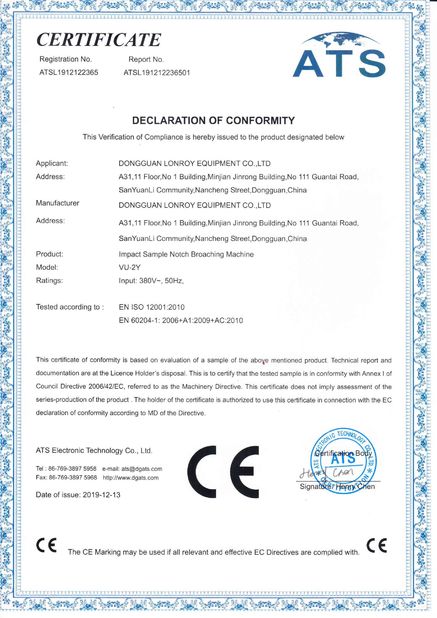
Standards Implemented
GB/T 50081-2019 "Standard Test Methods for Physical and Mechanical Properties of Concrete"
GB/T 3159-2008 "Hydraulic Universal Testing Machine"
GB/T 2611-2022 "General Technical Requirements for Testing Machines"
Function Overview
The 200T pressure testing machine is designed in accordance with national standards GB/T 50081-2019 "Standard Test Methods for Physical and Mechanical Properties of Concrete", GB/T 3159-2008 "Hydraulic Universal Testing Machine", GB/T 2611-2022 "General Technical Requirements for Testing Machines", and user requirements. This testing instrument is suitable for determining the compressive strength of concrete cube specimens.
Main Features
1. The control, main unit, and oil source modules adopt an integrated design, resulting in a compact structure, smaller overall size, reduced footprint, and aesthetically pleasing appearance. The shorter oil circuit length makes the oil pipe layout clearer and neater.
2. The integrated structure design, with the oil source located at the bottom, provides a low center of gravity. The main impact energy is released by the hydraulic unit, effectively reducing the impact and noise during specimen fracture, making ground vibration less noticeable.
3. It uses a double-flange tension-compression bidirectional load cell, which has a reasonable structure, excellent performance, high measurement accuracy, and good linearity, avoiding the many disadvantages associated with using oil pressure sensors and improving the accuracy of force value measurement.
4. It uses a retractable photoelectric encoder with high measurement accuracy, reaching 1 μm. It can not only measure and control the displacement of the piston but also measure and control the position of the piston.
5. Industrial touch screen manual operation and keyboard operation simultaneously meet the needs of users with different operating habits, making the design more user-friendly.
Specimen Preparation
1. The specimen is made from a single batch of mortar mixed with one part cement, three parts Chinese ISO standard sand, and a water-cement ratio of 0.5. The mortar is mixed using a planetary mixer and molded on a vibrating table, or a vibrating table with a frequency of 2800-3000 times/min and an amplitude of 0.75 mm can be used for molding.
2. The specimens, with the membrane intact, are cured in a humid environment for 24 hours, then demolded and cured in water until the compressive strength test.
3. At the test age, the specimens are removed from the water for the compressive strength test.
4. The temperature of the specimen molding laboratory should be maintained at a relative humidity of not less than 50%.
5. The temperature of the curing chamber or fog room for specimens cured with the membrane should be maintained at a relative humidity of not less than 90%.
6. The temperature of the curing tank should be maintained within the specified range.
7. The air temperature and relative humidity of the curing room and the water temperature of the curing tank should be recorded at least once a day during working hours.
8. The temperature and relative humidity of the curing chamber or fog room should be recorded at least every four hours. Under automatic control, the number of recordings can be reduced to twice a day.
Test Procedure
1. Start the oil source and control console power supply, rotate the power switch clockwise to the ON position, and the power indicator light will illuminate.
2. Place the specimen on the base with the casting surface as the bearing surface, ensuring it is centered without eccentricity.
3. After placing the specimen, press the lifting button on the left side of the control console to control the motor to rotate the nut, and the screw moves downward through the screw-nut mechanism until the lower ball seat surface is 1-2 cm away from the upper surface of the specimen.
4. According to the test requirements, set the required data for the test on the control software interface of the control console. The software setting program starts the test according to the test procedure (see "MaxTest" for detailed software operation instructions). During this process, the hydraulic cylinder piston rises to apply pressure to the specimen until the expected pressure is reached.
5. When the specimen breaks, the control console records the pressure at the time of failure and quickly unloads the load under the control of the control console.
6. Clean the remaining fragments of the specimen from the base, keep the screw adjustment mechanism in place, and directly place the next specimen for repeated pressure testing.
7. After multiple tests, use a soft brush or air nozzle to promptly clean the scale and debris from the testing machine to keep it clean.


 Your message must be between 20-3,000 characters!
 English